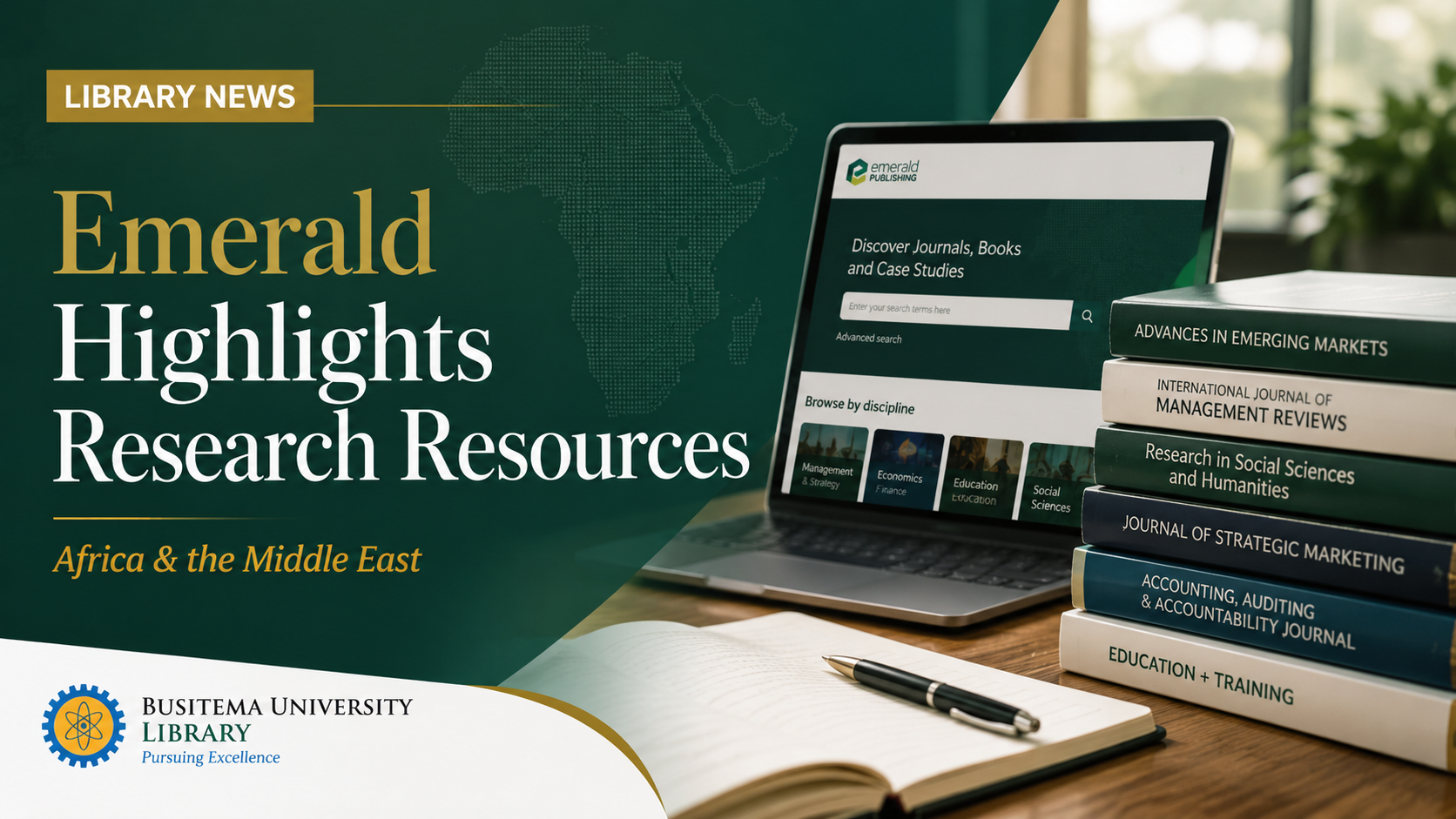
Emerald Highlights Research Resources with a Strong Focus on Africa and the Middle East
Busitema University Library is drawing the attention of students, researchers and academic staff to a selection of research resources recently highlighted by Emerald Publishing, with particular focus on Africa and the Middle East.
The selection brings together journal articles, case studies, books and engineering research covering subjects ranging from artificial intelligence and social media regulation to African economic development, inflation, finance, water sustainability and infrastructure.
What makes the collection particularly interesting is the range of real-world issues it addresses. Some of the featured studies look at challenges facing African countries, while others examine developments in the Middle East and other emerging economies. Together, they provide useful material for teaching, classroom discussion, independent study and research across several disciplines.
Technology features strongly among the resources highlighted by Emerald.
One of the case studies, the case of X/Twitter in Pakistan: regulating social media platforms, looks at the difficult questions that arise when governments attempt to regulate large global social media platforms.
Social media has become an important part of communication, business, politics and public debate, but its rapid growth has also created challenges around regulation, misinformation, freedom of expression and the responsibilities of technology companies.
By examining the situation in Pakistan, the case gives readers an opportunity to think about how governments can respond to these challenges without ignoring the wider social and economic role that digital platforms now play.
Another case study takes technology into a very different setting.
Digital Karam: AI meets Arabian hospitality traditions explores how artificial intelligence can be introduced into hospitality while maintaining the traditions and values associated with Arabian hospitality.
Artificial intelligence is increasingly being used to automate services, analyse customer information and improve business operations. However, hospitality is also built around human interaction, trust and culture.
The case therefore raises an important question. How can organisations benefit from new technology without losing the cultural and human qualities that make their services distinctive?
The subject is especially timely as organisations across different sectors continue to explore how artificial intelligence can be used responsibly and effectively.
Emerald's featured journal research also turns attention to finance and the economic challenges that countries and businesses continue to face.
Influence of Shariah compliance and Muslim directorship on stock price crash risk examines the relationship between Shariah compliance, company leadership and stock-market risk.
The research contributes to the growing body of knowledge around Islamic finance and corporate governance. It looks at how the way a company is governed, including the composition of its leadership, may be connected to its behaviour and performance in financial markets.
This provides an interesting area of study for those working in finance, accounting, economics, business and management, particularly as Islamic finance continues to grow in different parts of the world.
A second economic study brings the discussion closer to Africa.
Post-COVID inflation and monetary policy in Morocco: analysis using a Bayesian VAR model looks at what happened to inflation in Morocco following the COVID-19 pandemic and how monetary policy responded.
The pandemic disrupted economies across the world. As countries began to recover, many faced rising prices, pressure on household incomes, changes in energy costs and difficult decisions about interest rates and monetary policy.
By focusing on Morocco, the study provides an African example of these wider economic challenges and gives readers an opportunity to examine how one country responded to the pressures that followed the pandemic.
For researchers interested in African economies, the value of such studies goes beyond Morocco itself. They can provide points of comparison when studying inflation, monetary policy and economic recovery in other countries on the continent.
Understanding Africa's Development
Africa receives even greater attention in two of the books included in Emerald's selection.
African Economic Development examines some of the major forces that have shaped, and continue to shape, economic development across the continent.
Economic development in Africa cannot be explained by one issue alone. Questions of agriculture, institutions, industrialisation, poverty, public policy, climate change and access to opportunities are closely connected.
The book brings these different issues together, providing a broader picture of the challenges countries face as well as the opportunities available for future growth.
This makes it relevant not only to economics but also to development studies, agriculture, public administration, policy studies and other disciplines concerned with Africa's transformation.
The second title, The Emerald Handbook of African Studies, takes an even wider view.
Rather than looking at Africa from one academic discipline, the handbook brings together perspectives on the continent's economic, social, political and business environment.
This kind of multidisciplinary approach is important because many of the issues affecting African societies cut across traditional academic boundaries. Economic decisions can influence communities and politics, while developments in technology, business and governance can also shape wider social change.
For anyone carrying out research on Africa, having access to perspectives from different fields can help build a more complete understanding of the subject being studied.
Engineering Research Responds to Environmental Challenges
The featured resources also show how engineering research is increasingly responding to environmental and sustainability concerns.
Nature-aligned engineering in coastal infrastructure development: a systematised review looks at how coastal infrastructure can be developed in ways that work more closely with natural systems.
Traditionally, infrastructure development has often focused mainly on constructing physical solutions to a problem. Today, engineers and planners are increasingly being asked to consider how those solutions affect the surrounding environment and whether natural systems can become part of the answer.
This is especially important in coastal areas, where communities may be dealing with erosion, changing weather patterns, rising environmental pressures and the effects of climate change.
The study therefore brings together engineering and environmental thinking in considering how coastal infrastructure can become more sustainable and resilient.
Water sustainability is the focus of another featured study, Investigating rainwater harvesting potential for water sustainability in Tigray, Ethiopia.
The research explores how rainwater harvesting could contribute to improved water security and better management of available water resources.
The subject is particularly relevant in parts of Africa where communities face unreliable rainfall, prolonged dry periods and increasing pressure on water supplies.
Rainwater harvesting is not a new idea, but research can help determine where such systems are most suitable and how they can form part of wider approaches to water management.
For countries dealing with climate change, agriculture and growing demand for water, research of this kind has clear practical importance.
Research That Reflects Regional Experiences
One of the strengths of the resources highlighted in this Emerald selection is the attention given to issues being experienced within Africa, the Middle East and other emerging regions.
Academic research is most useful when readers can connect it with the questions and challenges they encounter in their own fields and communities.
A student studying economics can examine Morocco's experience with post-pandemic inflation. Someone interested in environmental sustainability can explore rainwater harvesting in Ethiopia. Engineering researchers can look at new approaches to coastal infrastructure, while those studying business and technology can examine how artificial intelligence is changing hospitality.
The collection also shows how closely today's research areas are connected.
Artificial intelligence is no longer only a computer science subject. It raises questions about business, culture, ethics and employment. Climate change is not only an environmental issue; it affects engineering, agriculture, economics and development. Social media is not simply a communication tool; it has become an important subject in governance, business and public policy.
Having access to research from different disciplines gives students and researchers an opportunity to look at these connections and develop a broader understanding of the issues they are studying.
Supporting Teaching, Learning and Research
The featured resources can be used in different ways across the University.
Case studies provide situations that lecturers can bring into classroom discussions, allowing students to consider how concepts learned in class apply to real organisations, governments and communities.
Journal articles can help researchers follow recent developments in their fields, build literature reviews and identify questions that may require further investigation.
Books and handbooks provide the broader background often needed before moving into more specialised research.
For students, regularly working with such materials can also strengthen the ability to find, read, compare and evaluate academic information rather than depending on a single source.
Exploring Emerald Through Busitema University Library
Members of the Busitema University community who would like to explore Emerald can begin from the Electronic Resources section of the Busitema University Library website, where Emerald is listed among the Library's electronic databases.
Users can follow the Library's Emerald access route to search for relevant journals, books and other scholarly materials available to them.
Since access may vary depending on the particular title or collection, users are encouraged to check individual resources through the Library's Emerald platform rather than assuming that every item highlighted in the Emerald newsletter is available in full text.
Anyone experiencing difficulty accessing Emerald or identifying appropriate academic resources can seek assistance from Busitema University Library staff.
The Library encourages students, researchers and academic staff to explore these highlighted resources and the wider Emerald collection as they continue to strengthen their teaching, learning and research.