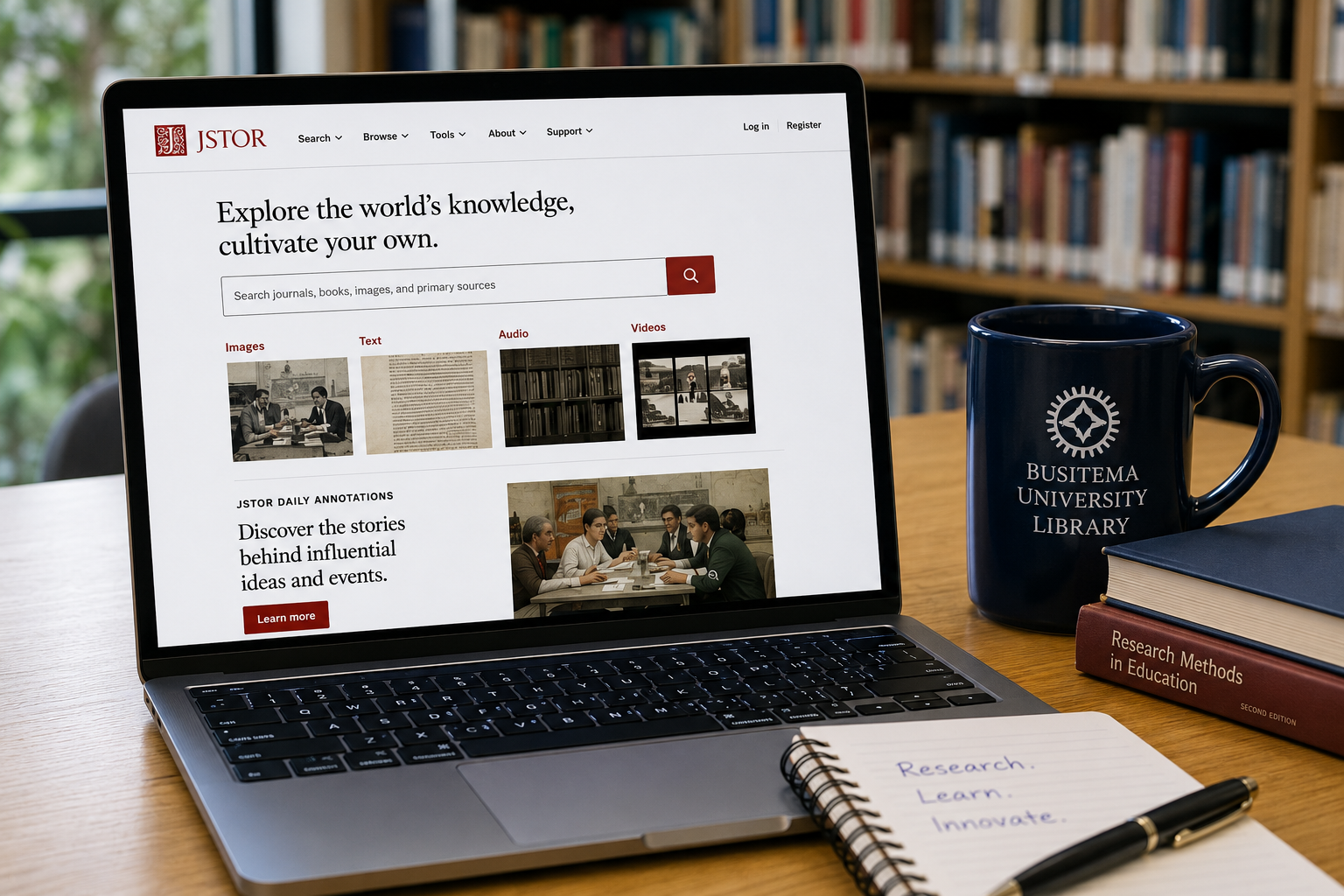
JSTOR Expands Support for Digital Collections, Global Access and Research-Based Learning
JSTOR has announced new initiatives intended to improve access to scholarly knowledge, strengthen the visibility of distinctive library collections and help students, researchers, academic staff and librarians use academic resources more effectively.
The July 2026 updates are relevant to the Busitema University community and members of the Consortium of Uganda University Libraries, or CUUL. They cover expanded support for digitising special collections, more equitable access to JSTOR resources, opportunities for librarians and educators to share professional experiences, and learning tools that connect influential historical texts with academic scholarship.
Increasing access to distinctive collections
University libraries and archives often hold valuable materials that cannot be found elsewhere. These may include photographs, manuscripts, maps, newspapers, institutional records, oral histories and other primary sources. Primary sources are important because they provide direct evidence about an event, period, institution or community. Students and researchers can use them to develop original arguments instead of relying only on interpretations presented in textbooks and journal articles.
Through JSTOR Stewardship, JSTOR is helping libraries and archives improve the processing, digitisation, preservation and discovery of their distinctive collections. According to JSTOR, support from the Mellon Foundation will enable participating institutions to expand digitisation activities that may previously have been limited by cost, technology or staffing.
Digitisation involves more than scanning documents. Materials must also be organised, described, stored securely and made searchable. Without clear descriptions and reliable metadata, a digital collection may remain difficult for students and researchers to discover.
JSTOR Stewardship combines collection processing, digital asset management, discovery and long-term preservation within one environment. Participating institutions can make their collections available through the JSTOR platform while retaining their institutional identity and branding. JSTOR reports that libraries have already made more than three million collection items openly available through the platform.
Using artificial intelligence to process collections
One of the tools supporting JSTOR Stewardship is JSTOR Seeklight, an artificial intelligence-enabled system developed with librarians and archivists. JSTOR states that more than 50 libraries are already using Seeklight to address backlogs of unprocessed materials.
A library backlog may include photographs, documents, manuscripts or institutional records that have not been fully catalogued. Until such materials are described and organised, researchers may not know that they exist.
Seeklight is intended to assist libraries with processing materials at scale. It can support the creation of descriptions and metadata, while librarians and archivists provide the professional judgement needed to verify accuracy, preserve context and address ethical concerns.
This is an important lesson for students and professionals interested in artificial intelligence. AI can improve speed and efficiency, but human oversight remains necessary, especially when dealing with historical, cultural or community-based materials.
Connecting primary sources with scholarly literature
Collections published through JSTOR Stewardship can appear alongside journal articles, books and other scholarly materials available on JSTOR. This creates useful links between original evidence and the scholarship that interprets it.
A student researching the history of agriculture in Uganda, for example, may consult institutional records, historical photographs or government documents together with journal articles on agricultural policy and rural development. A researcher studying cultural heritage may combine oral histories, architectural records or photographs with published studies on preservation, identity and community memory.
For Busitema University and CUUL institutions, this model demonstrates how local collections can contribute to national, regional and international scholarship. University libraries may hold important records relating to agriculture, engineering, health sciences, education, environmental studies, institutional history and local communities. Digitising and describing such materials could make them more useful for teaching, research and public knowledge.
Supporting long-term digital preservation
Digitising a document does not automatically guarantee that it will remain accessible. Digital files can be lost through damaged storage devices, system failures, obsolete formats, weak backup procedures or changes in technology.
JSTOR indicates that collections shared through Stewardship are supported by long-term preservation infrastructure. The aim is to ensure that materials digitised today remain trustworthy and usable for future scholarship. This principle also applies to individual researchers. Research data, interview recordings, photographs and draft documents should not be stored only on a personal laptop, phone or flash drive.
Researchers should maintain organised folders, clear file names, multiple backups and basic documentation explaining how files were created and arranged.
Expanding access through equitable fee models
JSTOR has also published an update on making JSTOR more accessible worldwide.
For more than 20 years, JSTOR has used country-based savings to reflect differences in the economic circumstances of institutions around the world.
JSTOR also operates the JSTOR Access Initiative, which provides eligible institutions with free or very low-cost access to selected archival journals, primary sources and books. From 2027, JSTOR will use the United Nations Human Development Index to guide eligibility and access tiers.
The Human Development Index considers life expectancy, expected years of schooling, average years of schooling and gross national income per person. This allows JSTOR to consider education and human development alongside economic conditions.
The approach is relevant to universities in countries where library budgets, internet infrastructure and access to scholarly publishing may be limited.
Sharing successful library and teaching practices
JSTOR is also inviting librarians, educators and research support professionals to share their experiences through the Collaborate with JSTOR programme. Contributions may explain how JSTOR has been used in teaching, research support, information literacy or collections work.
A librarian could document how students were taught to refine database searches, evaluate academic sources or distinguish between scholarly and non-scholarly information. An academic staff member could explain how JSTOR materials were incorporated into an assignment, reading list or classroom discussion.