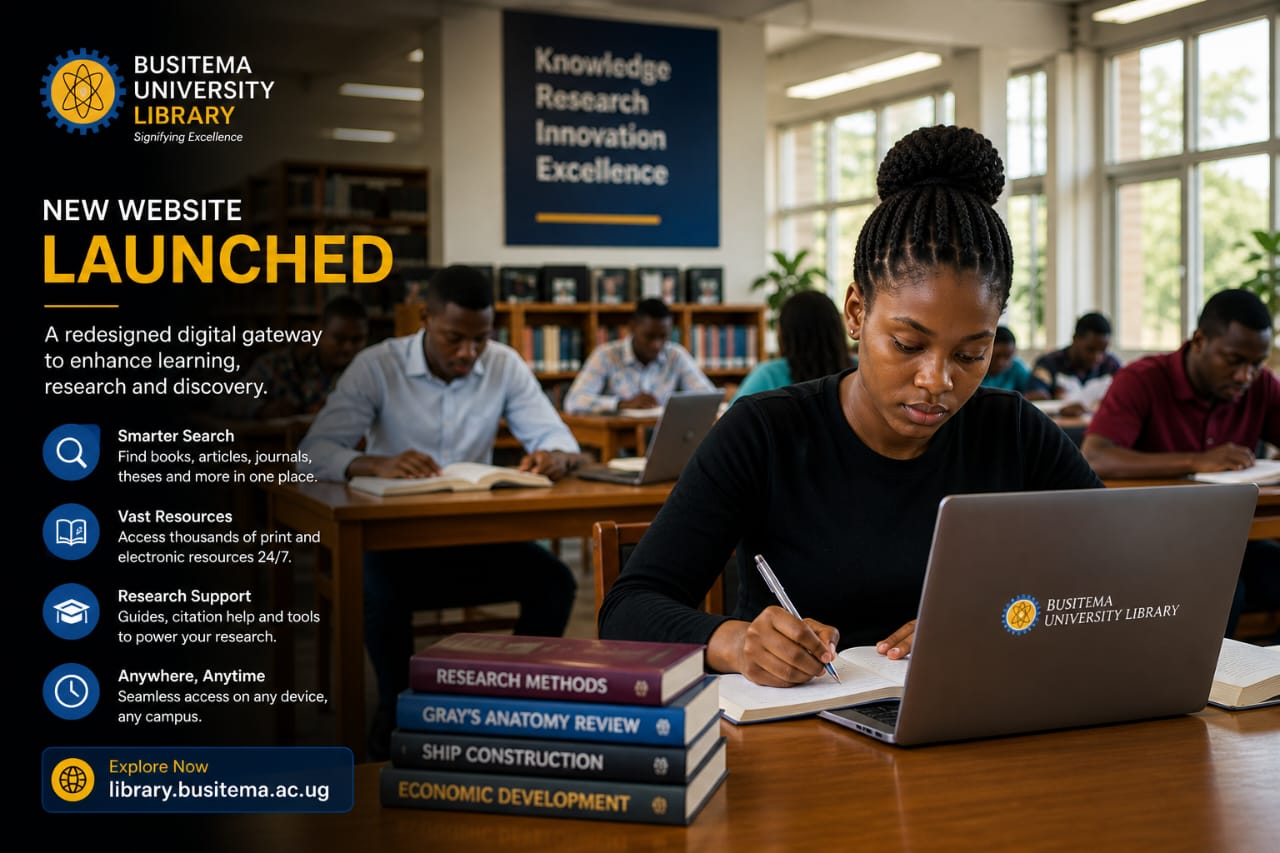
Busitema University Library Website: A Redesigned Digital Gateway to Enhanced Learning and Research
Busitema University Library has officially unveiled its comprehensively redesigned website, now accessible at https://library.busitema.ac.ug/. The launch represents a substantive enhancement of the library’s digital infrastructure, directly responding to the evolving scholarly needs of students, faculty, and researchers across the university’s six campuses. The new platform delivers a streamlined, intuitive user experience that unifies the library’s extensive physical and electronic collections, thereby reinforcing the library’s position as the intellectual hub of Busitema University.
Behind the clean, user-friendly interface lies a substantial and growing repository of knowledge. The library’s holdings include over sixty-five thousand print volumes distributed across its campus libraries, complemented by access to more than thirty-five thousand electronic journals. The Busitema Institutional Repository alone contains nearly six thousand titles, contributed by more than twelve hundred and fifty authors across thirty-seven scholarly communities. With over eight hundred daily study seats available across all campuses, the library has long been a cornerstone of academic life. The redesigned website ensures that this wealth of material is no longer confined to physical shelves or disparate digital silos but is instead discoverable through a single, cohesive gateway.
Central to the redesign is a powerful, multi-functional search engine that accommodates the distinct ways users seek information. Unlike many academic portals that offer only a basic keyword search, the new Busitema library website provides five specialized search modes. Users can conduct an Easy Search that queries both the library’s collections and external academic databases simultaneously. Those seeking print materials can perform a Specific Book Search by author, title, subject, or call number, with the ability to filter results by individual campus libraries such as the Maritime Institute Library or the Health Sciences Library. A dedicated Journal or Article Search retrieves full-text content from the library’s extensive e-resource portfolio. For access to local scholarship, the Institutional Repository Search allows direct discovery of theses, dissertations, and research papers produced at Busitema. Additionally, seamless integration with Google Scholar enables users to search the broader scholarly web without leaving the library portal.
Recognizing that effective research requires more than just search tools, the new website features curated Research Guides designed to help students and staff discover high-quality sources, strengthen their research methodologies, and write with greater confidence. A dynamic “New Arrivals” section showcases recent acquisitions across disciplines, from medical texts like Gray’s Anatomy Review at the Health Sciences Library to technical works such as Ship Construction for Marine Engineers at the Maritime Institute Library. This feature gives the university community immediate visibility into the latest materials added to the collection, supporting both current coursework and long-term scholarly inquiry.
To ensure that the community fully benefits from these new capabilities, the library has organized a series of hands-on training sessions throughout the current month. One session, held at the ICT Lab on the Main Campus, introduces students to the university’s electronic databases, journals, and research platforms. Another workshop, taking place in the Library Training Room at Mbale Campus, focuses on proper citation practices and avoiding plagiarism using reference management tools like Zotero and Mendeley. At the E-Learning center on the Main Campus, participants receive guidance on literature review techniques, academic search strategies, and managing research sources. Finally, an online Zoom session teaches users how to search, access, and download theses and research papers from Busitema University’s Institutional Repository. These diverse offerings reflect the library’s commitment to meeting users where they are, whether in person or remotely.
The redesigned website also provides clear, up-to-date information on library hours for each campus. For example, the Arapai Campus library is open weekdays from eight in the morning until ten in the evening, and weekends from eight in the morning until six in the evening, with public holidays observed as closures. Users can easily find branch-specific hours for Nagongera, Mbale, Pallisa, Namasagali, and the Main Campus directly on the site, along with contact information for each location. This transparency eliminates guesswork and helps students and staff plan their research visits efficiently.
This digital transformation aligns with Busitema University’s broader strategy of leveraging technology to enhance teaching, learning, and research outcomes. By centralizing access to print volumes, electronic journals, the institutional repository, and research guides under one intuitive interface, the library reaffirms its mission to provide equitable, round-the-clock access to credible, vetted information. Students balancing coursework with clinical rotations, faculty members teaching across multiple campuses, and researchers collaborating on interdisciplinary projects will all benefit from this twenty-four-hour gateway. Moreover, the website’s responsive design ensures that users on laptops, tablets, or smartphones enjoy a consistent and functional experience.
The new Busitema University Library website is live and available to all. Members of the university community are encouraged to visit https://library.busitema.ac.ug/ to explore the improved features and resources. For questions, feedback, or to schedule a group training session, users may contact their respective campus library directly through the information provided on the new site. With this redesign, Busitema University Library demonstrates that a modern, user-focused digital presence is not a luxury but a necessity for any institution committed to academic excellence in the twenty-first century.